
Grand Chute Directory Years
The verified shelf is a set of surviving points, not a complete annual run. Appleton's first known city directory dates to 1874. Official digital or collection evidence also supports an 1884 item, Wright's 1887 to 1888 volume, the 1901 Bunn & Ferry directory, and a 1915 directory. The 1901 book explicitly includes Grand Chute among its covered communities.
| Directory collection | Verified years | Where kept | Access route |
|---|---|---|---|
| Early Appleton city directory | 1874 | Local history collections | Confirm through library catalog or staff |
| Appleton digital items | 1884 and 1915 | Fox Valley Memory and partner collections | Free digital discovery where available |
| Wright directory | 1887 to 1888 | Fox Valley Memory | Digitized text and scans |
| Bunn & Ferry city and telephone directory | 1901 | Milwaukee Public Library digital collection | Free online scan |
| Broader directory shelf | Years vary | Appleton Public Library Jabas Collection | Library resources and researcher help |
No verified last printed year or complete publisher sequence was located. Missing years must stay gaps. Ask the library to confirm a volume before planning a visit, and never infer that a person was absent from Grand Chute because one year is unavailable.
Grand Chute Directory Timeline
Grand Chute's documentary trail predates the directory shelf. The first town meeting took place on April 3, 1849 at W.S. Warner's Appleton home. Outagamie County was organized on February 17, 1851. Those facts explain why early family material may appear under town, Appleton, county, or older regional labels.
| 1849 | Grand Chute holds its first town meeting in Appleton. |
|---|---|
| 1851 | Outagamie County is formally organized. |
| 1874 | Appleton's first city directory begins the verified local directory era. |
| 1887 to 1888 | Wright publishes a volume with residents, firms, classified listings, and institutions. |
| 1901 | Bunn & Ferry includes Grand Chute and both name and street pages. |
| 1915 | Another verified Appleton directory provides a later comparison point. |
The county's growth from river settlement through timber, mills, paper, manufacturing, and food trades also changes the terms worth searching. Try township names, initials, occupations, firms, and nearby place labels instead of one modern spelling.
Grand Chute in the 1901 Directory
The 1,152-page Bunn & Ferry volume is the strongest verified bridge for a Grand Chute city directory search. It combines alphabetical citizens and firms, telephone material, an Appleton street section, Outagamie County pages, organizations, and nearby communities. That mix matters because a Grand Chute person may be indexed under a name page while the address context sits in an Appleton street or county section.
The Milwaukee Public Library scan of the 1901 volume shows the collection record.
The collection page provides a stable citation, but the page image remains the authority for spelling and layout. Generated transcripts are useful discovery tools and can misread narrow type, initials, and street abbreviations.
Note: An Appleton heading does not by itself prove that the residence fell inside Appleton's municipal boundary.
Decode Grand Chute Directory Entries
A directory compresses a household clue into a short line. The 1901 sample entry includes a surname and given name, a spouse in parentheses, a work role and employer, then a residence or rooming address. Widow notation can identify a deceased spouse. Always read the abbreviation key because marks vary by volume.
| Name | Usually the listed adult or business, with initials that need cross-checking. |
|---|---|
| Spouse | A name in parentheses can distinguish two people with the same surname. |
| Work role | An occupation or firm gives a second identity point. |
| Residence | A house number and street may follow a residence or rooming mark. |
| Widow note | A widow abbreviation can supply the deceased spouse's given name. |
The sample 1901 entry scan shows how much meaning can fit in one line.
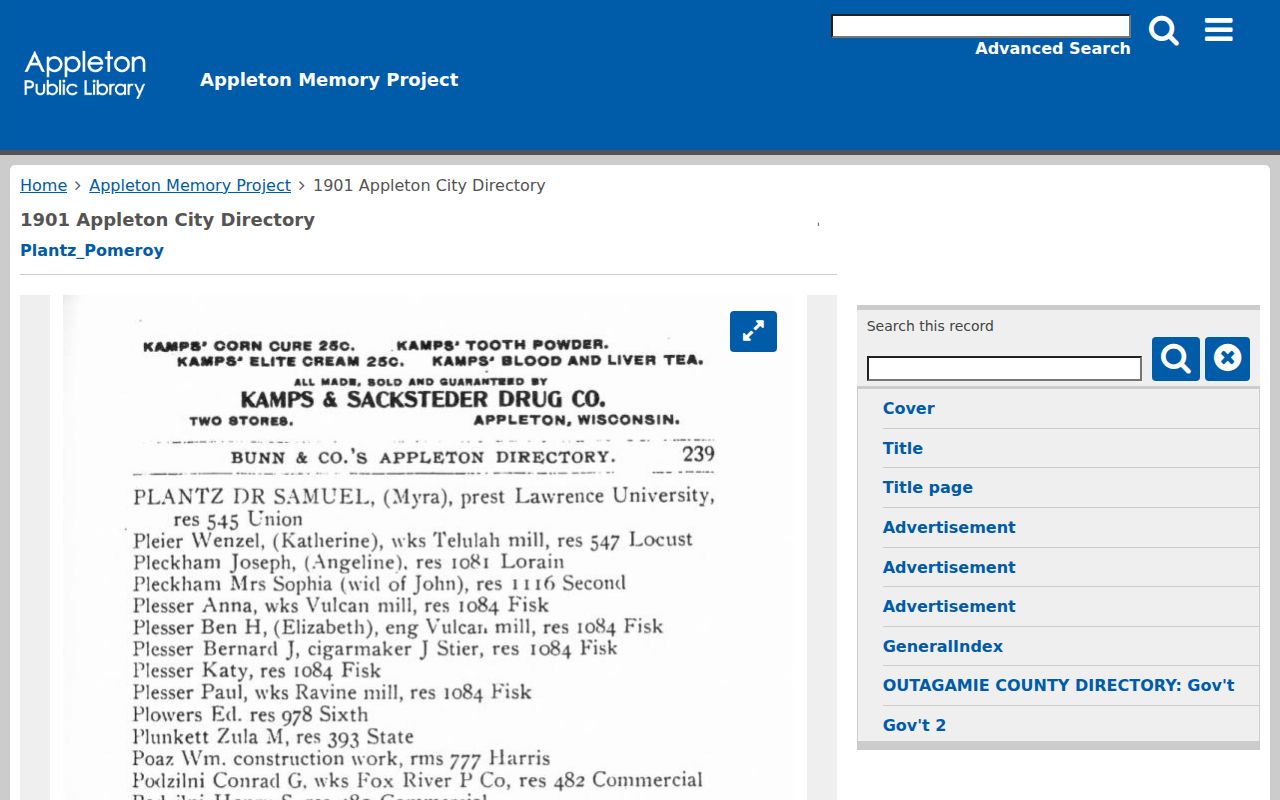
Use the scan to correct OCR and preserve punctuation. A spouse, role, and exact residence together are far stronger than a surname match alone.
- Criss-cross directory
- A section arranged by street and number so an address can lead to a printed occupant or firm.
- Householder index
- An address-oriented list of named household heads, not a full list of everyone present.
- Abbreviation key
- The volume's own legend for terms such as residence, rooms, widow, work, or ownership marks.
Reverse Grand Chute Street Pages
Name pages answer where a listed person was printed. Street pages reverse the question: who or what appeared at a number in that volume? Move from the known address to the street section, copy every relevant line, then return to alphabetical entries for fuller identity clues.
A street listing may be a firm, institution, boarding location, or rooming site rather than a private family home. Compare the parcel, plat, Sanborn map, or newspaper before deciding what kind of place it was. Modern address-keyed records are handled separately in the Grand Chute street directory.
No verified townwide renumbering year was found. If an old number does not map cleanly, use a legal description, subdivision plat, nearby cross streets, and dated maps. Do not assign a modern parcel by guesswork.
Use Grand Chute Library Resources
Appleton Public Library's Don & Betty Jabas Appleton Collection is the strongest named local repository. It includes historical directories, plat maps, yearbooks, Sanborn maps, books, photographs, and newspapers. Microfilm reaches back to 1853, while selected Post-Crescent content spans 1860 to 1972 and ProQuest covers 1999 to the present.
Access can be digital, in person, by microfilm, or through staff research help. The library's partial obituary index may supply a newspaper and date, and researchers can request an article by email. Genealogy Jumpstart began in 2025, adding guided help alongside the Find Your Ancestors program that began in 2014.
Fox Valley Memory and the Appleton Memory Project add digitized directories, plat maps, building surveys, photos, and pioneer biographies. Use transcript text to locate a page, then cite the scan. This route is especially useful when a volume is not fully searchable.
The library's access channels serve different needs. Search the open digital collections from home, use licensed databases with a library card or inside the building, ask staff to check the obituary index, and visit the microfilm room for issues that have not been digitized. Published hours differed across the source pages reviewed, so confirm the current schedule before traveling.
Bridge Grand Chute Directory Gaps
The 1884 and 1915 items are useful fixed points around the 1887 to 1888 and 1901 books, but they do not create a continuous run. Between verified volumes, use federal census schedules that are already public, plat books, newspaper dates, vital indexes, and cemetery or obituary material. Each source answers a different question.
The Wisconsin Historical Society Outagamie County plat-book record includes Grand Chute Township. A plat links a family or owner name to land at a particular period, while the directory links a listed name to an address or role. Sanborn maps add building context, but no exact local year set was verified in the research.
Wisconsin Historical Society also holds pre-1907 vital material and county collections. County genealogy staff refer researchers to the History Museum at the Castle and area archives. Ask each repository for a date and record group rather than assuming a private roster is open.
Trace Grand Chute Family Years
A directory works best as a sequence of dated snapshots. Follow the same person only when initials, spouse, role, address, or another detail agrees. Pairing directory years with public census years can fill a long gap, while a newspaper or obituary may explain a move or disappearance.
- Start with the volume closest to a known event and copy the entry exactly, including abbreviations.
- Search the prior and next verified volume for the surname, initials, spouse, occupation, and address.
- Check the street section to learn what else the directory printed at that number.
- Compare the nearest public census and a plat or map, keeping each source's date distinct.
- Use the obituary index, newspaper microfilm, probate, or cemetery records when the listing stops.
A missing name can mean a move, death, new spelling, changed marital name, omission, or unavailable volume. It does not prove any one event. Grand Chute grew from 1,779 people in 1900 to 2,018 in 1920, then to 23,831 in 2020, so early rural records should not be forced into today's dense street grid.
Grand Chute Directory Boundaries
Historical directories were commercial publications, not censuses. They could omit children, unlisted adults, rural families, newcomers, and people the canvasser missed. A printed occupation may be stale. A rooming address may not be a household, and an Appleton label may hide a Grand Chute location.
Search Grand Chute, Appleton, Outagamie, township references, nearby communities, initials, married names, and OCR variants. German, Scandinavian, Menominee, and wider Fox Valley history may shape names in sources, but never use that context to guess a person's identity or ethnicity.
Best evidence. Treat every printed entry as a dated clue. Confirm the page image and pair it with an independent census, land, newspaper, vital, or probate record.
No complete publisher run, final print year, official church-directory set, or open organization-member roster was verified. Library and archive staff are the proper next channel when the digital trail ends.